Agricultural Pole Barns and Horse Barn Builders in Spokane, WA
Equipment storage, hay bays, and horse barns with loafing sheds, built for Spokane County and North Idaho acreage. Post-frame construction handles the wide clear spans agricultural buildings need without interior support posts breaking up the space.
Agricultural barns: equipment, hay, and feed
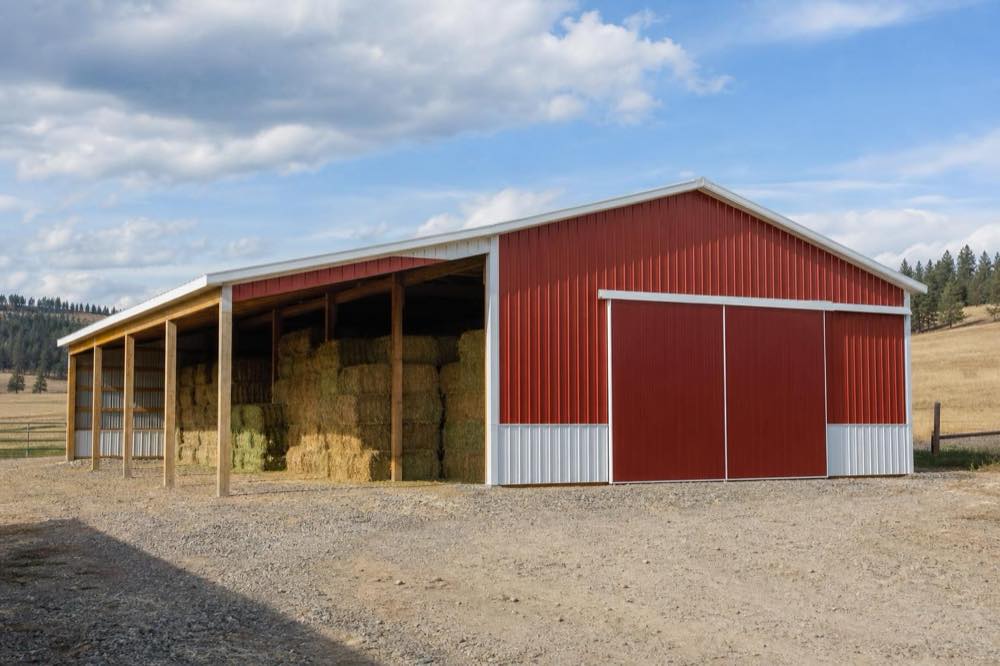
A general agricultural pole barn on a Spokane County or Kootenai County property usually needs to do more than one job: shelter tractors and implements, store hay out of the weather, and hold feed close to where livestock actually are. Post-frame construction handles that well because the wide-open clear span between posts leaves room to lay out separate bays without interior columns getting in the way of equipment or stacked hay.
A common layout splits the building into an enclosed bay for equipment and feed, protected from weather and rodents, and a separate open-sided or ventilated bay for hay. Keeping hay away from equipment and fuel reduces fire risk, and separate bays make it easier to manage moisture in the hay itself, which affects quality more than raw square footage does.
Horse barns and loafing sheds
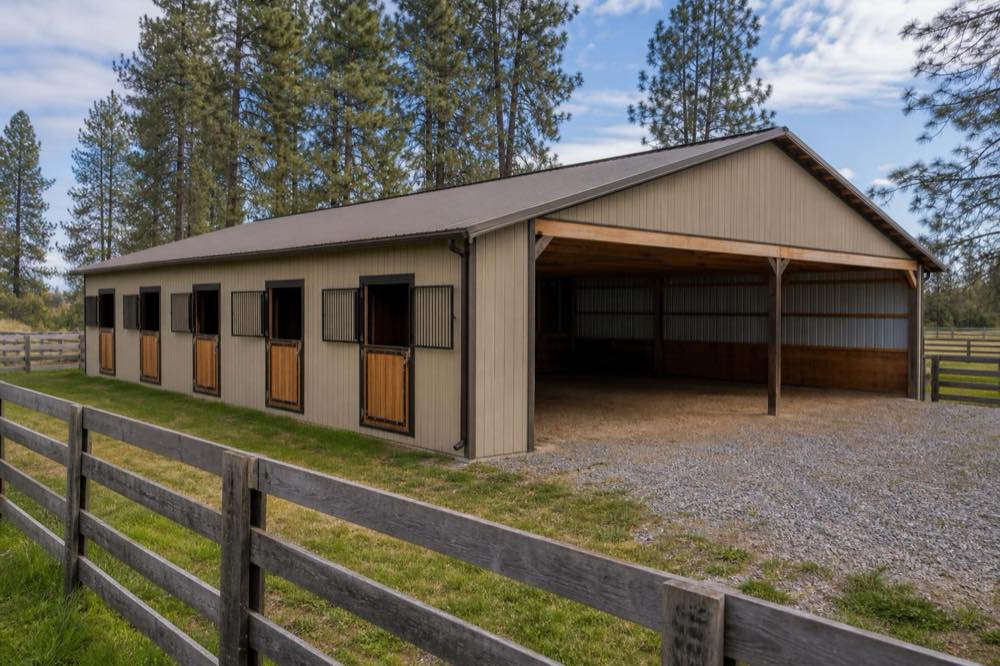
Horse barns add a different set of considerations: stall layout, aisle width for handling horses safely, and ventilation to manage ammonia and moisture that build up in an enclosed space. A loafing shed, by contrast, is an open-sided roofed shelter horses can move in and out of freely, without individual stalls. Many properties use both: a fully enclosed barn for stalled horses and a loafing shed for pasture turnout, sized around herd count and how the property gets used day to day.
Stall sizing is worth a real conversation rather than a rule of thumb. A commonly used baseline is a roughly 12-foot by 12-foot stall, but the right size depends on the horse's build, how much time it spends stalled versus turned out, and whether the barn needs room for foaling or extra equipment storage alongside the stalls. Aisle width matters just as much as stall size, since a cramped aisle makes everyday handling harder and slower than it needs to be.
Does your agricultural building need a permit?
The two states diverge here, and the rules shouldn't be blended together. Idaho Code Section 39-4116 exempts true agricultural buildings from the state building code, though a location permit is still generally required, and the exemption applies to genuine farm use rather than any building that happens to sit on rural land. Spokane County and the City of Spokane don't carry an equivalent agricultural exemption; a building permit applies, with the BP-14 non-engineered pathway available for qualifying pole buildings up to 3,000 square feet and 36 feet wide under the same snow load cap that governs shops and garages. Confirm the specific rule for your parcel and building use before finalizing plans, since "agricultural" isn't a self-defining term for permitting purposes in either state.
Get a quote on an agricultural or horse barn
Tell us your acreage, building use, and location, and a local post-frame builder will follow up. See barndominiums if you're also planning a home on the same property.
Agricultural and horse barn questions
How much space does a horse barn need per horse?
Stall sizing depends on the horse's size and how the stall gets used, so treat any flat number as a starting point. Many horse owners plan around a roughly 12-foot by 12-foot stall as a common baseline, then adjust with a builder or equine specialist for breed, turnout access, and herd size.
Do agricultural pole barns need a permit?
Yes in most cases, though Idaho treats true agricultural buildings differently than Washington does. Idaho Code Section 39-4116 exempts agricultural buildings from the state building code, though a location permit is still required, while Spokane County and the City of Spokane require a building permit with the BP-14 pathway available for qualifying non-engineered structures.
What's the difference between a loafing shed and a horse barn?
A loafing shed is an open-sided, roofed shelter horses can move in and out of freely for weather protection, with no enclosed stalls. A horse barn is fully enclosed with individual stalls, aisles, and typically a tack or feed room. Many properties use both: a barn for stalled horses and a loafing shed for pasture turnout.
Can one building combine equipment storage and hay storage?
Yes, a single agricultural pole barn commonly splits into separate bays: one enclosed for equipment, tractors, or feed, and one open-sided or ventilated bay for hay. Keeping hay in its own bay away from equipment reduces fire risk and makes it easier to manage moisture, which matters more for hay quality than raw square footage.
Does a horse barn need special ventilation?
Ventilation matters more in a horse barn than most agricultural buildings, since ammonia from manure and moisture from breathing and hay both build up in an enclosed space. Ridge vents, eave openings, and stall windows are common ways to keep air moving without a full mechanical system. A builder can size ventilation to the barn's layout and stall count.